
Custom Brass Jewelry Batch Consistency
The interesting question about a plated brass order is not whether the first sample looks right, it is whether the third batch looks like the first. Consistency comes from documented repetition rather than skilled hands: eight named steps, 100% inspection and ISO 9001:2015 as the management system behind them, on a minimum of 100 pieces per design in artisan eco-brass. This page is about what actually drifts.

Key takeaways
- Consistency is a documented-process claim: eight steps, 100% inspection and ISO 9001:2015.
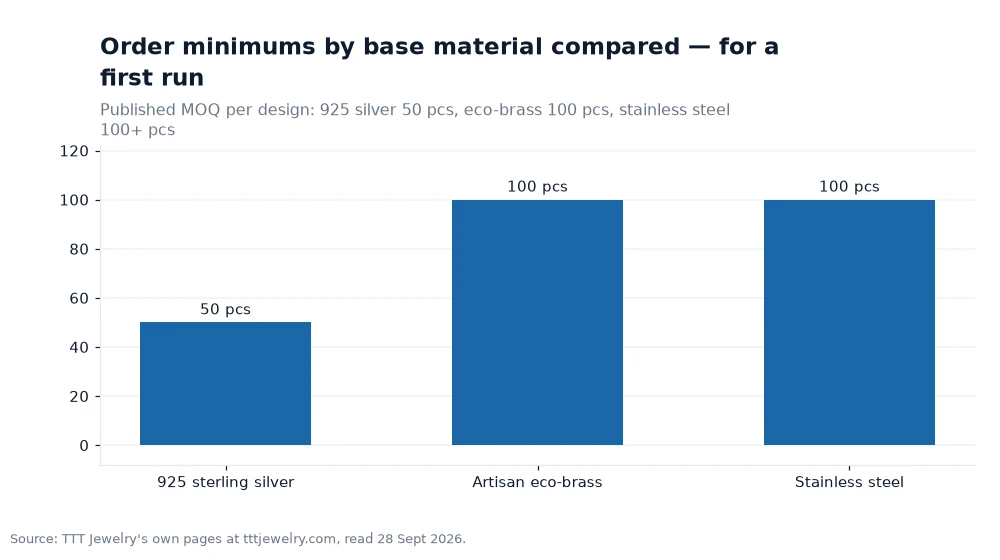
- Order floors are 50 pieces in the silver line, 100+ pcs in stainless steel and 100 units in the eco-brass line, counted per design, so a two-design range doubles those figures.
- The variables that drift are plating chemistry, polishing pressure, stone lots and mould wear.
- Repeat orders should be shorter than first orders, since the mould and the plating recipe already exist.
Why the third batch is the difficult one
A first batch is made carefully because it is new. A third batch is made by whoever is on shift, using a mould that has already run twice and a plating bath that has processed other orders in between. That is the gap a documented process closes: not by making everyone equally skilful, but by making the steps identical so that the difference between batch one and batch three can be found and fixed.
ISO 9001:2015 is a quality management system, which is precisely a claim about repetition rather than about output. It says the factory records what it does and does it again the same way, and that is the property a brand actually needs when it reorders a piece six months after launch.
What drifts, and where you would notice it
Four things move on a plated brass line. Plating chemistry changes as a tank is used, which shows up as a tone difference between two runs of "the same" finish. Polishing pressure varies between operators, which shows up on flat faces and on edges where the metal is thin. Stone lots change colour and size slightly, which shows up in a setting that looked tighter in the sample. And moulds wear, which shows up as a shape that gets fractionally softer over time.
All four are visible at inspection if the inspection knows what to compare against. That is why the approved sample matters more than the specification sheet: it is the physical reference that survives every later argument about whether a batch is within tolerance.
The eight steps as a consistency checklist
Concept design, prototyping, sprue cutting, polishing, surface art, electroplating, final inspection and delivery — the sequence is fixed, and the order is the mechanism. Polishing before plating means the plate goes onto a known surface; surface art before plating means a texture is cut into metal rather than through a coating; inspection before packing means the check happens while the pieces are still in the factory.
Change the order and consistency breaks in ways that are hard to see. Plate first and polish later and every batch differs by how much plate the polishing removed. Inspect after packing and the fix for a bad batch becomes unpacking cartons, which is why 100% inspection is placed before the last step rather than after it.
| Item | Published figure | Why it affects consistency |
|---|---|---|
| Factory steps | 8 named operations | A fixed sequence is what can be repeated |
| Inspection | 100% of the batch, before packing | Every piece is compared, not a sample |
| Minimum, eco-brass | 100 pcs per design | Several runs are tooled from one mould |
| Minimum, 925 silver | 50 pcs per design | The silver route tool more often |
The plating recipe is the hardest thing to hold steady
14K, 18K or 24K gold, silver and brass sealed with an anti-tarnish e-coat, rhodium plating and vacuum PVD plating for steel for durability.
For a brand, the practical move is to record the recipe used on the approved sample and ask for it by reference on every repeat. Tone is the first thing a customer notices and the last thing a specification sheet captures, so the approved sample plus a written recipe is the only combination that settles a colour dispute later.
If you see brass collections across several seasons
Look at the joins rather than the faces. A collection photographed over two years shows its wear at the clasp, the jump ring and the stone setting long before it shows anything on a flat polished surface, and those are exactly the places where plating and coating depth are thinnest. That is also where a batch difference becomes visible to a customer.
The second thing to compare across seasons is colour. A collection shot under different lighting hides tone drift; a set of pieces compared side by side on one bench does not. If a brand has pieces from more than one run, that comparison is the simplest batch audit available.
Manual inspection is the consistency control
The brass line finishes with manual inspection covering five named judgements: craft, finish, gem setting, size and structure. That list is why batch consistency is achievable at all, because each item is a comparison against the approved sample rather than a general impression. A piece that plates slightly darker than the last run can still be inside the finish standard; a piece whose setting sits at the wrong depth cannot.
The line's own material statements support the same story. Nickel content meets certified standards, the metal conforms with REACH and California Prop 65, gold and rhodium plating layers form a durable barrier that suits most skin types, and the brass is 100% recyclable. None of those claims varies between batches, which is exactly what a reorder needs.
Worked example: counting pieces and inspections over a year
A four-design brass range at the published 100-piece floor is 4 × 100 = 400 pieces per production run. Run it three times in a year and that is 1,200 pieces, and because inspection is 100% rather than sampled, it is also 1,200 individual checks. The MOQ is a floor per design, so the quantity is set by how many designs you carry, not by how many pieces you want.
Now compare with silver. The same four designs at 50 pieces per design is 4 × 50 = 200 pieces per run, which is 200 ÷ 400 = 50% of the brass volume, so the brass figure is 400 ÷ 200 = 2 times the silver one. My arithmetic; the 100 and 50 are the published minimums. The consistency question gets harder as volume rises, because more pieces per run means more pieces made between two checks of the tank.
Frequently asked questions
How do you check that a repeat batch matches the first?
Compare it against the approved physical sample at the joins and on colour, and ask for the plating recipe recorded on the first order to be used again.
Does a higher minimum make a batch more consistent?
Not by itself. The 100-piece eco-brass floor affects how often a design is tooled, while consistency comes from the fixed step sequence and 100% inspection.
What should a brand keep from the first order?
The approved sample, the plating recipe, the hallmark position and the packaging specification, since those four items are what a repeat order is measured against.
Building a reorder file worth keeping
Photograph the approved sample under one light source, write the plating recipe next to the design number, and note which of the eight steps the sample's finish depends on most. Then keep the inspection record with it, because a delivered batch without a record is a batch you cannot compare against anything. A brand that keeps those three things can reorder a piece a year later and make a judgement in one afternoon rather than one sampling cycle. The MOQ stays at 100 pieces per design for eco-brass however long the gap is, so the file costs nothing to keep and saves a full window when it is used. Brands running several materials at once usually keep the comparison on the wholesale color and finish pages, and the compliance side of the same file is set out on the OEM/ODM overview.
What this article works from — the REACH and California Prop 65 compliance and the gold and rhodium plating layers and the anti-tarnish e-coating on silver — is written up at the manufacturer's own site on the tttjewelry.com site on 28 Sept 2026. The relative figures in the chart are mine, not the site's[1].